

Sector Update / Plantation / Click here for full PDF version
Author(s): Halima Yefany ; Aurelia Barus
- We expect 2H26F earnings to beat consensus on higher CPO prices, with resilient yields and limited levy pressure supporting the upside.
- However, we see FY27F earnings downside as drop in yield may outweigh the increase in price.
- We maintain tactical OW on 2H26F earnings recovery, while FY27F yield decline is a key downside risk. Our top picks are: and .
Attractive near-term outlook with strong 2H26F earnings outlook
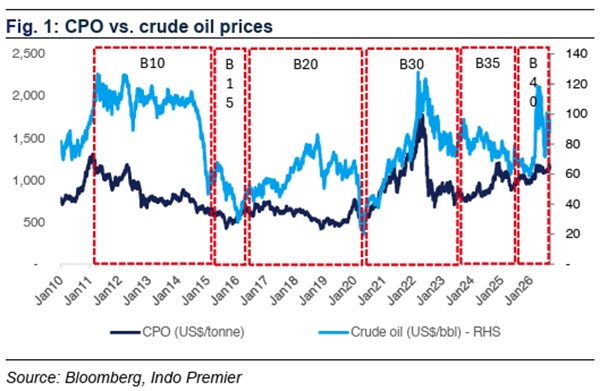
We expect the near-term sector outlook to remain supportive, with 2H26F earnings are likely to beat consensus on higher CPO prices and resilient operation. CPO prices should trend higher on B50 implementation and stronger Indian's festive demand, with elevated crude oil prices providing further upside. YTD, CPO prices have moved by around half the magnitude of crude oil prices with a c.4-7-day lag. Meanwhile, El Nio and wildfire impact on operational remain limited (see our report on crude oil and El Nino). Levy risk remains manageable under B50, as 1H26 levy revenue of Rp21tr exceeded Rp17tr in subsidy payments, keeping BPDP funding positive and limiting near-term levy hike risk.
FY27F: price needs to double to offset the drop in yield
We see downside risk to sector earnings in FY27F as weaker yields could outweigh higher CPO prices. If El Nio-driven dryness persists through Oct-26, we estimate FY27F palm yields could decline by 15-17% yoy (vs. our current est. of -1% to -5% yoy), similar to 2016. On a more positive note, we see limited levy risk in FY27F, as the BPDP fund could remain in surplus until end-2026, as crude oil prices are expected to stay elevated. We run a sensitivity on our base-case estimates: every 10% yoy yield decline would need to be offset by a 20% yoy increase in average CPO prices (MYR5.4k/t). We also see that, in the year after El Nio, the discount of CPO prices to soy oil narrowed, averaging 4-11%. Thus, based on this, CPO prices could reach a maximum of MYR5.5-5.9k/t (22-32% yoy), assuming soy oil prices increase by 6% yoy in FY27F, in-line with consensus, which may not be sufficient to offset yield decline. Overall, unless CPO prices increase by twice the magnitude of the yield decline, earnings could still decline yoy.
B60 offers upside potential in 2H27F, but implementation remains challenging
The government plans to implement B60 in FY27F, potentially reducing seaborne CPO supply by 10-13%. If implemented in 2H27F, B60 could support CPO prices and push CPO to a premium over soybean oil, as seen in 2H24. (Fig 23) CPO prices have historically risen 11-29% yoy during periods of higher biodiesel blending and El Nio. However, limited HVO capacity, high costs, and feedstock availability are the key challenges, so we exclude B60 from our base case for now. (Pgs 10-13)
Maintain tactical OW
We maintain our tactical OW call on the plantation sector, supported by a 2H26F earnings recovery on higher CPO prices. is our top pick, given its strong operational outlook and attractive valuation. Going into 2027F, we see lower yields as the key downside risk, which is not yet fully reflected in consensus earnings. Key risks: geopolitical tensions, and regulatory changes.
Sumber : IPS